
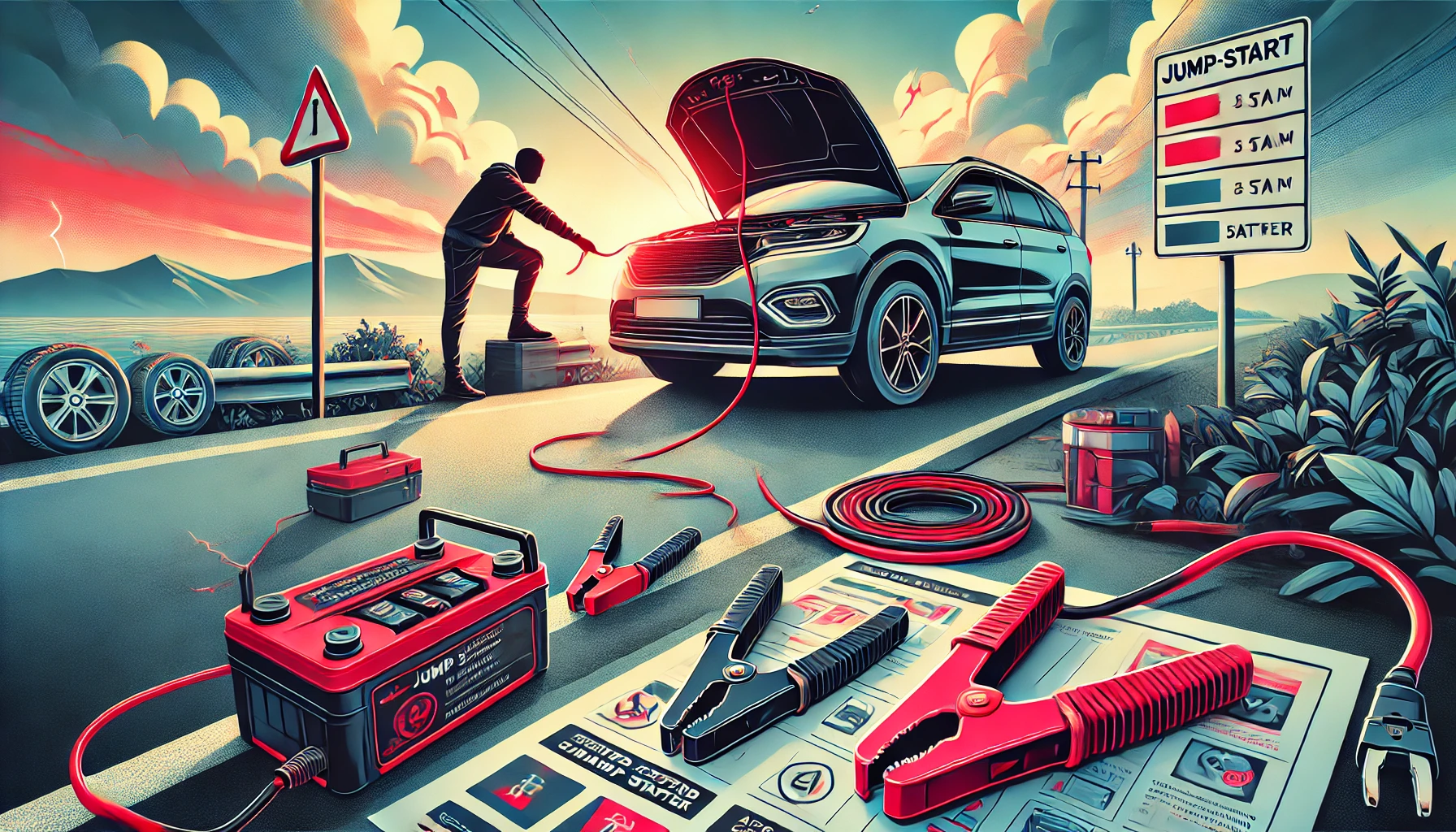

Jumpstarting a car sounds simple, but the truth is — one wrong step can damage your battery, your cables, or even your vehicle’s electrical system. At Five Star Roadside, we’ve been helping drivers in 32 U.S. cities for years, and we know that when your car battery dies, speed and safety matter most. So, here’s how to jumpstart a car.
Step One – Preparation for Jumpstarting
How to Prepare for Jumpstarting a Car
To prepare for jumpstarting, you first ensure both vehicles are off, parked close but not touching, and in “Park” or “Neutral” with parking brakes set. The cables must be long enough — ideally 12 to 20 feet — so you have slack to work without strain. For compact cars, 8-gauge cables work fine; for trucks or SUVs, use 4-gauge cables rated to handle 220 amps with minimal voltage drop. This preparation prevents awkward connections and ensures power flows efficiently.
Step Two – Identify the Battery Terminals
How to Identify Battery Posts Before Jumpstarting
To identify battery posts correctly, you locate the positive (+), often under a red cover, and the negative (-), typically bare metal. Mistaking them risks reverse polarity, which can cause sparks, blown fuses, or fried electronics. Always match positive to positive and negative to negative when planning connections.
Step Three – Connect the First Positive Clamp
How to Attach the Positive Cable First
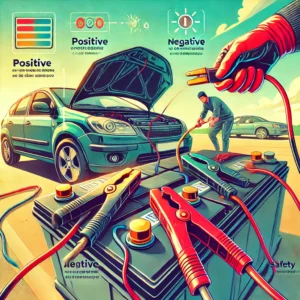
To attach the positive clamp first, you connect the red clamp to the positive terminal of the assisting (good) battery. This ensures the live source is ready to send current. Using the correct order reduces spark risk and ensures clean current flow.
Step Four – Connect the Second Positive Clamp
How to Secure the Second Positive Clamp
To secure the second positive clamp, attach the other end of the red cable to the positive terminal of the dead battery. The connection should be firm, with full clamp-to-post contact to handle up to 200 amps during cranking.
Step Five – Connect the First Negative Clamp
How to Connect the First Negative Cable Safely
To connect the first negative cable, clamp the black cable to the negative terminal of the good battery. This grounds the circuit on the source side before completing the loop.
Step Six – Connect the Second Negative Clamp
How to Ground the Second Negative Cable
To ground the second negative cable safely, attach it to an unpainted metal surface like an engine bracket on the dead vehicle. This avoids igniting hydrogen gas that can escape from the battery during charging.
Step Seven – Start the Assisting Vehicle
How to Power the Dead Battery from the Good Vehicle
To power the dead battery, start the assisting vehicle and let it run for at least 5 minutes. This allows enough current to flow so the dead battery reaches a cranking voltage — typically around 12.2V for ignition success.
Step Eight – Start the Dead Vehicle
How to Attempt Starting the Dead Vehicle
To attempt starting the dead vehicle, turn the ignition key or press the start button. If the engine doesn’t turn over within 5–7 seconds, stop, wait a minute, and try again. Continuous cranking overheats starter motors and cables.
Step Nine – Disconnect the Cables in Reverse Order
How to Remove Jumpstart Cables Safely
To remove jumpstart cables safely, disconnect the black clamp from the dead vehicle first, then the black clamp from the good vehicle, then the red clamp from the good vehicle, and finally the red clamp from the dead battery.
Step Ten – Recharge the Jumpstarted Battery
How to Recharge After a Jumpstart
To recharge after a jumpstart, drive for 15–30 minutes so the alternator fully restores battery charge. Short trips may not replenish enough power, leaving you stranded again.
Frequently Asked Questions
What is the correct order of connecting cables when jumpstarting?
The correct order is positive from the good battery, positive to the dead battery, negative from the good battery, and negative to the grounded metal on the dead vehicle.
Why should I connect the last negative clamp to metal and not the battery post?
Because connecting directly to the battery post risks igniting hydrogen gas that can accumulate around the battery.
How do I know which cable to connect first when jumpstarting?
You always connect the positive cable first to avoid accidental shorting between a live negative and grounded metal.
How many ways are there to jumpstart a car?
The number of ways to jumpstart a car generally comes down to four main methods: using jumper cables with another vehicle, using a portable jump starter, using a car battery booster pack, and push-starting a manual transmission. Each method has its own process, tools, and limitations, which means the right choice depends on your situation, vehicle type, and available equipment.
How to jumpstart a car with cables?
To jumpstart a car with cables, the process begins by positioning another vehicle close enough so the jumper cables reach both batteries. Connect the red cable to the positive (+) terminal of the dead battery, then to the positive terminal of the charged battery. Attach the black cable to the negative (-) terminal of the charged battery, then to an unpainted metal surface on the dead car’s engine block. Start the working car, wait 1–2 minutes, and then try starting the dead car.
How to jumpstart a car without cables?
To jumpstart a car without cables, the most common method is push-starting — which only works on manual transmission cars. With the ignition on and the clutch pressed, have helpers push the car until it gains some speed. Release the clutch quickly while in second gear. The momentum spins the engine, causing it to fire up without external cables.
How to jumpstart a car with a portable jump starter?
To jumpstart a car with a portable jump starter, the process starts by ensuring the device is fully charged. Connect the red clamp to the positive (+) terminal of the dead battery, and the black clamp to an unpainted metal surface on the car’s frame. Switch on the jump starter and attempt to start the car. Once the car is running, remove the clamps in reverse order.
How to jumpstart a car with a battery booster pack?
To jumpstart a car with a battery booster pack, the steps are almost identical to a portable jump starter. Attach the positive clamp to the positive terminal, and the negative clamp to a metal ground point. Activate the booster, wait a few seconds, and start the engine. Unlike jumper cables, this method works without another vehicle, making it ideal for emergencies in remote areas.
When should I avoid jumpstarting a car?
When the battery is cracked, leaking, or frozen — jumpstarting can cause it to explode.
Which vehicles require heavier gauge cables for jumpstarting?
Larger vehicles like trucks, vans, and SUVs require 4-gauge cables for safe, efficient current transfer.
Does a portable jump starter replace jumper cables?
Yes, a portable jump starter can replace cables, offering mobility without needing another car.
Do I start the assisting vehicle before connecting cables?
No, both vehicles should be off before you connect any cables.
If my car doesn’t start after a jumpstart, what should I do?
You should check for deeper electrical issues, a failed alternator, or severely drained battery that needs replacement.
Is it possible to jumpstart without cables?
Yes, using a portable jump starter or push-starting a manual transmission vehicle.
I drive an automatic car — can I push-start it instead of jumpstarting?
No, automatic transmissions cannot be push-started; they require a battery boost.
For how long should I run the assisting vehicle before trying to start mine?
Around 5 minutes is recommended for initial charging.
How can I tell if my cables are too thin for my car?
If they get hot during cranking or fail to start your vehicle, they may be under-gauged.
In which cases should I call Five Star Roadside instead of jumpstarting myself?
When you lack proper cables, feel unsafe, or suspect other mechanical issues.